
Microencapsulated
Threadlocking Coating
APET is a trusted Indian specialist in pre-applied microencapsulated threadlocking coating application for industrial fasteners in Faridabad, India. Our pre-applied dry threadlocker eliminates liquid adhesive application on the assembly line, delivering consistent torque performance, vibration resistance, and reliable thread sealing — suitable for applications where imported pre-applied threadlocking systems are commonly specified. Serving Faridabad, Ballabhgarh, Gurgaon, Manesar, Noida, Greater Noida, Delhi NCR and customers across India.
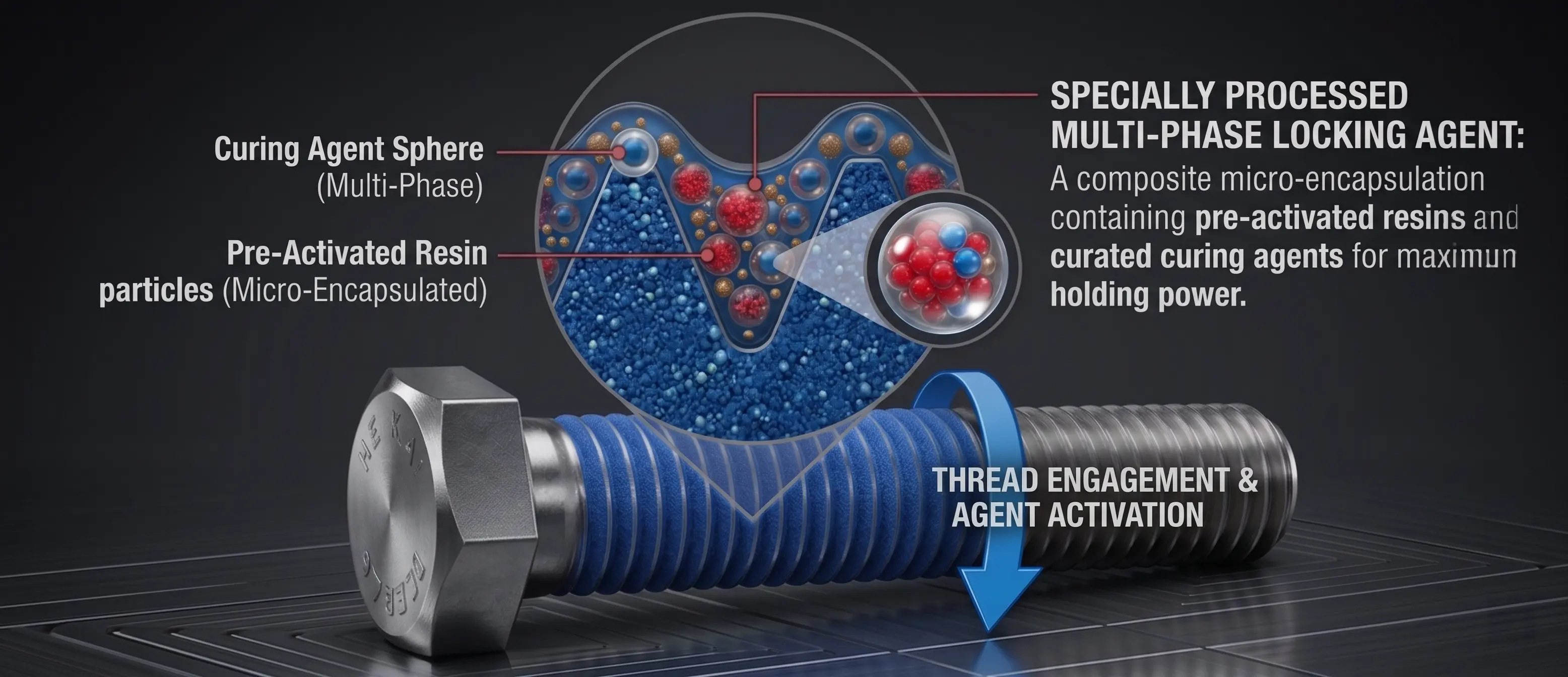
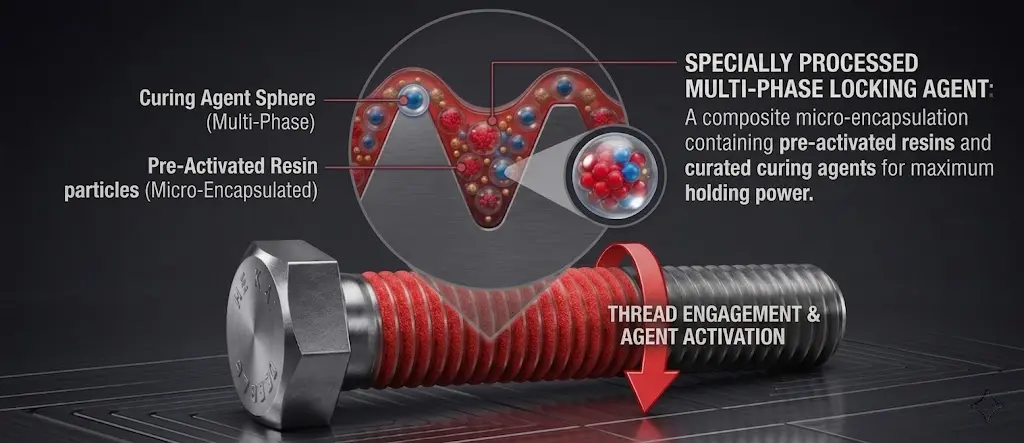
What is Microencapsulated Threadlocking?
Microencapsulation threadlocking is a pre-applied locking technology in which thousands of microscopic adhesive-filled capsules are coated directly onto the threads of a fastener. During assembly, these capsules rupture under compression and shear forces, releasing the adhesive, which cures and locks the threaded assembly against vibration-induced loosening.
At the visible level, the coating appears as a dry coloured band — commonly blue, red, green, orange, or turquoise — on the thread surface. Colour is used primarily for product identification and does not by itself indicate adhesive strength or performance. The dry-to-touch coating enables easy handling, long storage life (up to 4 years), and automated assembly without liquid adhesive application at the point of use.
APET is a coating service provider and application specialist — we apply pre-applied microencapsulated threadlocking coatings to customer fasteners using controlled, ISO 9001:2015 certified processes, suitable for applications where imported pre-applied threadlocking technologies are commonly specified.
How It Works — 4 Stages
Dry Coated Fastener
Thousands of microcapsules containing reactive adhesive components are uniformly applied onto the thread surface. The coating remains dry, stable, and non-reactive during storage.
Thread Engagement
During assembly, mating thread flanks generate localized contact pressure across the coated thread area.
Capsule Rupture & Release
The contact pressure ruptures the capsule walls, releasing resin and curing components that mix within the thread interface.
Cure & Lock
Polymerisation begins after assembly, forming a solid thermoset polymer within the thread clearances. The resulting bond provides resistance against vibration loosening while helping seal the threaded joint.
Working Principle — Technical Theory
Microencapsulation technology operates through the controlled rupture of adhesive-filled microcapsules. During assembly, thread engagement pressure breaks the capsules and releases the reactive components. The resulting polymerisation reaction forms a thermoset adhesive layer that fills thread clearances and creates resistance against vibration-induced loosening.
- Microcapsules are distributed uniformly across the fastener thread through a controlled coating process
- Thread engagement generates localised pressure at mating thread flanks
- Capsule walls rupture under assembly pressure and release the adhesive system
- Released resin reacts with encapsulated curing components distributed within the coating system
- Polymerisation initiates after assembly under ambient conditions
- A solid cross-linked thermoset polymer forms within the thread interface, creating the locking effect
Simplified Locking Relationship
The locking action is based on adhesive shear resistance. During assembly, microcapsules rupture and release resin and curing agents. The cured polymer fills thread clearances and bonds the mating threads, resisting loosening caused by vibration and dynamic loads.
- T — Breakaway torque
- τ — Shear strength of cured adhesive
- A — Effective bonded thread area
- r — Effective thread radius
This simplified relationship illustrates the influence of adhesive shear strength and bonded thread area. Actual breakaway torque depends on thread geometry, adhesive formulation, coating coverage, and assembly conditions.
Advantages of Pre-Applied Microencapsulated Threadlocking
- Ready-to-use system with no liquid adhesive handling at assembly
- Consistent and controlled adhesive quantity on every fastener
- Fully compatible with automated and high-volume assembly lines
- Excellent vibration and shock resistance after curing
- Long storage shelf life (up to 4 years) when stored under recommended environmental conditions
- Operator-independent process that minimises assembly variation
- Helps seal thread clearances against moisture, fluids, and contaminants
- Clean, dry handling without liquid adhesive dispensing
- Repeatable locking and torque performance across production batches
Microencapsulation vs Nylon Patch
Both technologies are pre-applied threadlocking systems, but they differ significantly in their locking mechanism, sealing capability, and reusability.
| Feature | Microencapsulation (APET) | Nylon Patch (APET) |
|---|---|---|
| Locking Mechanism | Chemical Thermoset Bond | Mechanical Interference |
| Sealing Capability | High Thread Sealing (DIN 267-27) | Selective / Moderate Sealing |
| Reusability | Single-Use (Primary) | 3–5 Assembly Cycles (DIN 267-28) |
| Vibration Resistance | High (Thermoset Lock) | High (Prevailing Torque) |
| Temperature Capability | –55°C to +120°C (Standard) | Up to ~120°C |
| Best For | Permanent / Semi-Permanent Joints | Adjustable / Serviceable Joints |
| Assembly Speed | Fast (Pre-Applied) | Fast (Pre-Applied) |
Microencapsulation vs Liquid Threadlocker
Pre-applied microencapsulation eliminates operator variability, liquid handling, and dispensing errors associated with liquid threadlocker applied at assembly.
| Feature | Microencapsulation (APET) | Liquid Threadlocker |
|---|---|---|
| Pre-Applied Capability | Yes (Factory Applied) | No (Applied at Assembly) |
| Assembly Variation | Very Low (ISO 9001 Controlled) | High (Operator Dependent) |
| Automated Line Speed | High (Bowl Feeder Ready) | Limited (Manual Dispensing) |
| Adhesive Volume Control | 100% Volumetric Control | Variable / Spill Risk |
| Handling State | Dry to Touch | Liquid / Messy Handling |
| Production Throughput | High Efficiency | Moderate / Bottleneck Risk |
| Reusability | Single-Use | Single-Use |
Industries Served
Automotive & Tier-1 OEMs
Engine assemblies, suspension systems, exhaust components, and safety-critical fasteners used in passenger and commercial vehicles. Widely used by OEMs and tier-1 suppliers in the Gurgaon–Manesar–Faridabad corridor.
Electrical Equipment & Switchgear
Switchgear, electrical panels, transformer assemblies, and enclosure fasteners requiring vibration resistance and thread sealing capability.
Industrial Machinery & Pumps
Pumps, compressors, gearboxes, rotating equipment, and industrial machinery operating under continuous vibration requiring reliable pre-applied locking.
Consumer Appliances
Washing machines, refrigerators, air conditioners, and other appliances assembled on high-speed production lines requiring consistent locking performance.
Renewable Energy Equipment
Solar mounting systems, wind energy assemblies, battery enclosures, and outdoor equipment requiring long-term vibration resistance and reliability.
Applications Requiring Controlled Locking
Applications requiring controlled locking performance, vibration resistance, and precision assembly across demanding industrial and engineering environments.
Relevant Standards
Pre-applied microencapsulated threadlocking coatings are commonly specified and evaluated against the following industry standards. APET's coating processes are aligned with DIN 267 Part 27 and ISO 9001:2015 quality systems.
Fasteners with microencapsulated chemical threadlocking and sealing coatings
Fasteners with polyamide prevailing torque coating (Nylon Patch)
Performance requirements for pre-applied threadlocking coating fasteners
APET quality management system certification for coating application
Applications Similar to Those Using Imported Threadlocking Systems
APET provides pre-applied microencapsulated threadlocking coating services for applications where imported threadlocking technologies are commonly specified — offering local coating application, technical support, ISO 9001:2015 quality processes, DIN 267 Part 27 aligned coating application, and pan-India supply for OEM and industrial customers.
Areas We Serve
APET provides microencapsulated threadlocking coating services to fastener manufacturers, OEMs and industrial customers across:
Frequently Asked Questions
Common questions about microencapsulated threadlocking coating from engineers, procurement teams, and quality managers across India.
Get a Quote for Microencapsulated Threadlocking
Share your fastener type, thread size, annual volume and industry. Our engineering team responds within one business day.