
Nylon Patch
Coating Services
APET provides specialized pre-applied polyamide (nylon) patch coating services for bolts, screws, studs, socket head cap screws, set screws, and custom threaded fasteners. The dry coating generates consistent prevailing torque to prevent vibration loosening and allows multi-use reusability without curing delays. Engineered as a functional alternative comparable to Tuflok® and Nylok® patch concepts**, APET delivers precision job-work across Faridabad, Ballabhgarh, Gurgaon, Manesar, Noida, Greater Noida, Delhi NCR, and Pan-India.
What is Nylon Patch Coating?
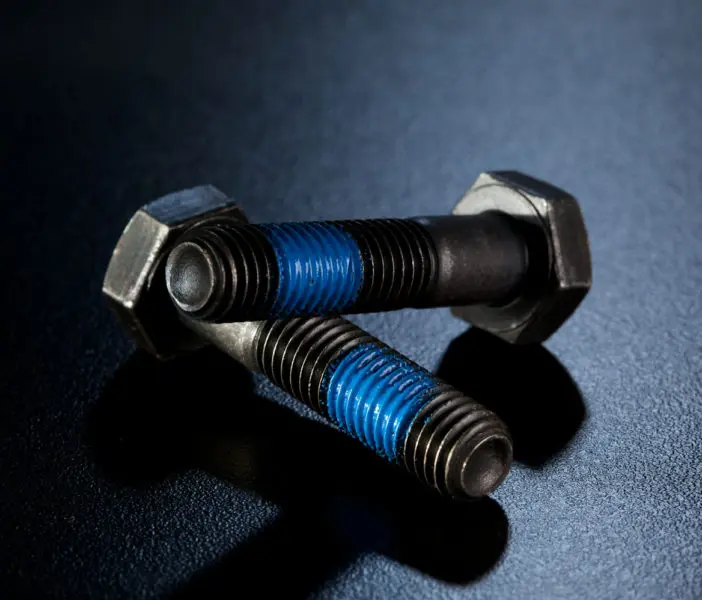
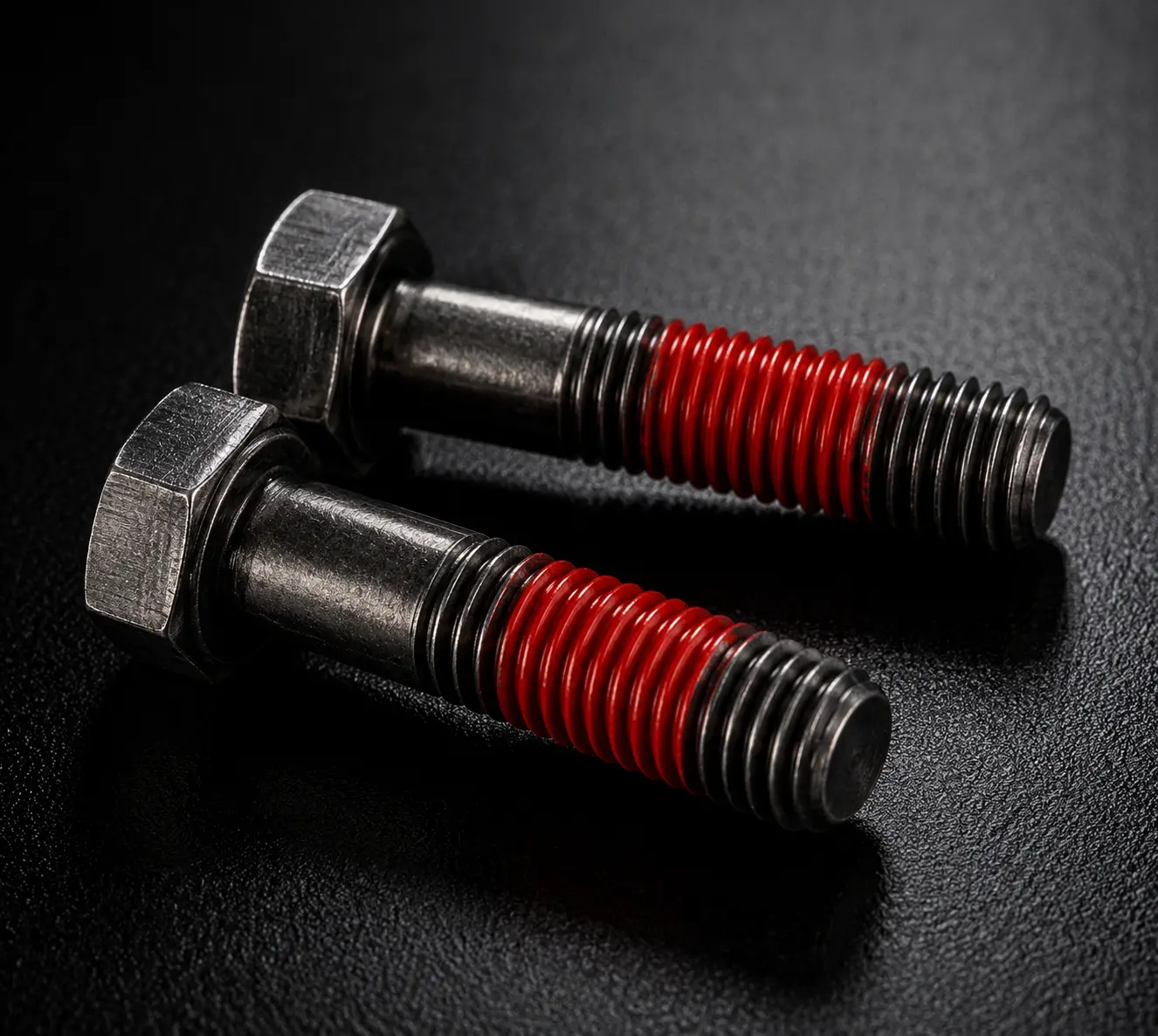
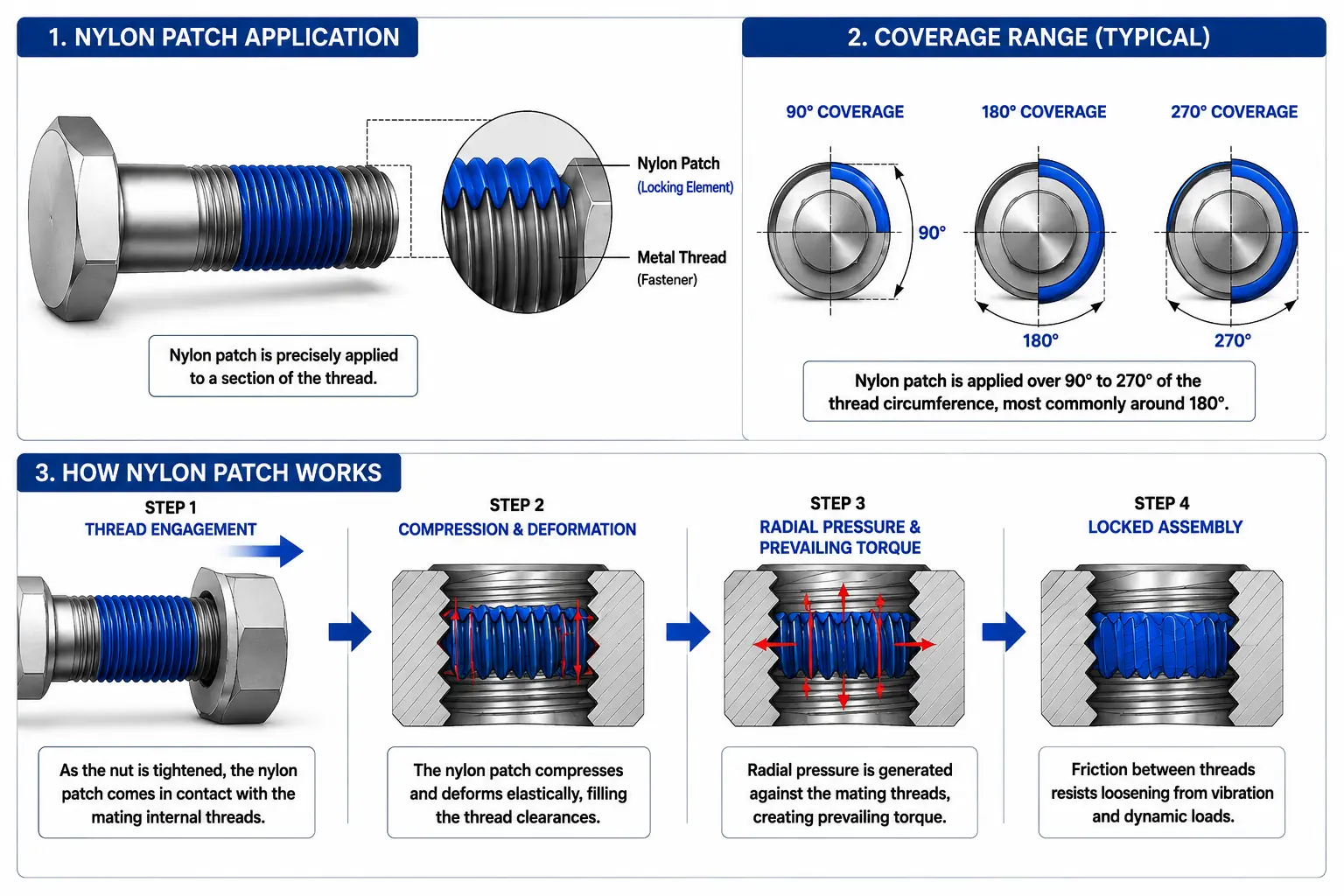
Nylon patch coating is a pre-applied thread locking solution in which a specially formulated polyamide (nylon) element is securely bonded to a selected portion of a fastener's threads. When the fastener is installed, the patch is compressed against the mating thread — acting as an interference element that generates radial pressure between mating threads, creating frictional resistance (prevailing torque) against vibration-induced loosening.
Unlike liquid thread lockers that require cure time after assembly, nylon patch coatings arrive ready for immediate installation — dry to the touch, clean to handle, and providing immediate prevailing torque without adhesive dispensing at the assembly point. APET provides nylon patch coating services for bolts, screws, studs, set screws, socket head cap screws, machine screws, and custom threaded fasteners for automotive, electrical, industrial, railway, HVAC, and OEM applications across India.
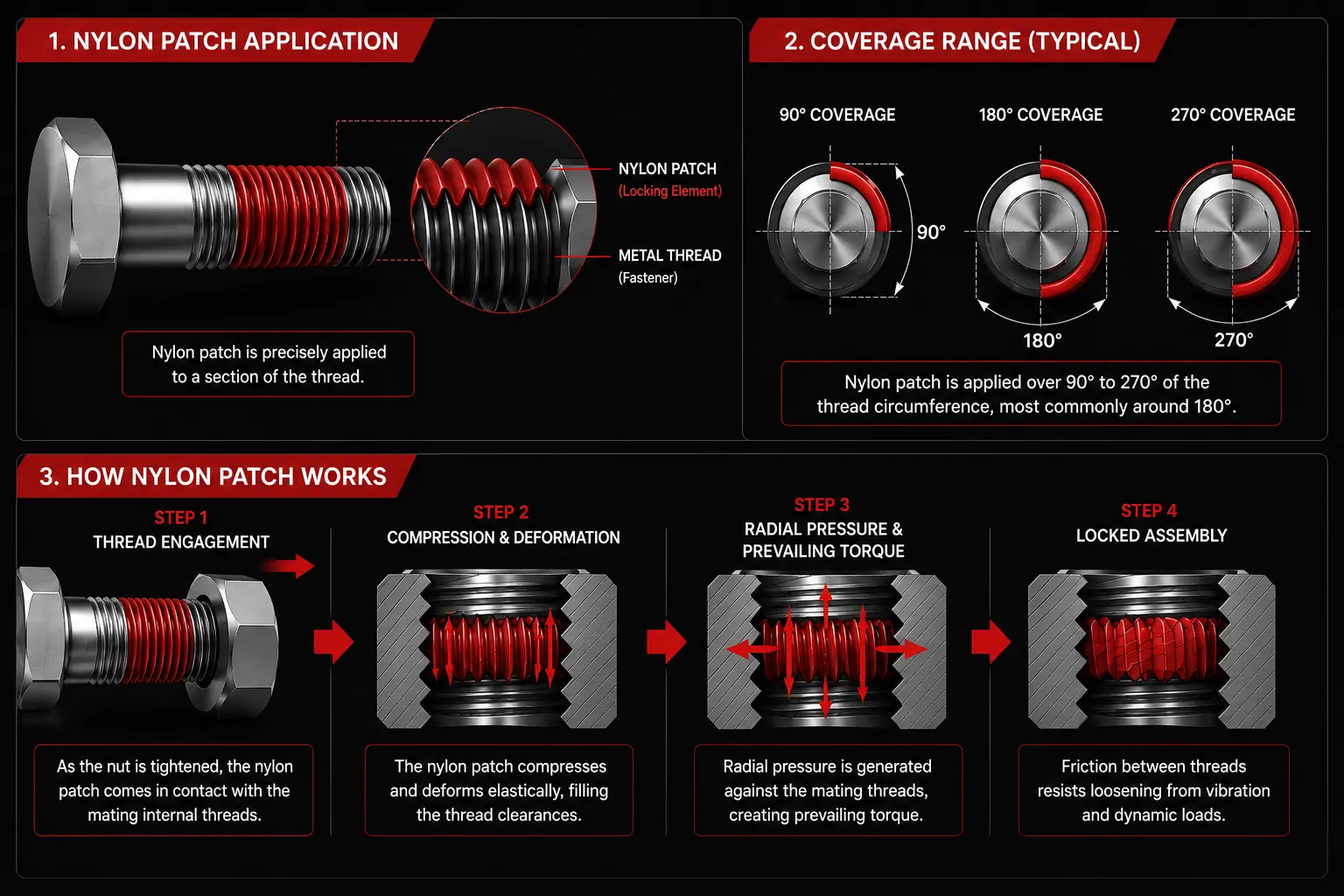
How Nylon Patch Coating Works — 4 Steps
Thread Engagement
As the fastener is tightened, the polyamide patch contacts the mating internal threads — acting as an interference element that generates radial pressure between mating threads.
Compression & Deformation
The nylon patch compresses and deforms elastically, filling thread clearances. This generates radial interference pressure between the male and female thread flanks.
Radial Pressure & Prevailing Torque
Radial interference pressure is generated against the mating threads, creating prevailing torque — frictional resistance that opposes rotational loosening under vibration and dynamic loads.
Locked Assembly
Friction between threads resists self-loosening throughout service. The nylon's elastic memory allows the joint to be removed and reinstalled while retaining useful prevailing torque over multiple cycles.
Principle of Nylon Patch Locking — Technical Theory
The locking action is based on interference fit and prevailing torque. When the coated fastener is threaded into the mating component, the nylon patch occupies part of the thread clearance. The resulting interference creates radial pressure between the male and female threads — generating friction that opposes rotational loosening under vibration and dynamic loads.
- T — Prevailing torque
- μ — Coefficient of friction between nylon and mating thread
- N — Normal force generated by nylon interference
- r — Effective thread radius
The formula illustrates the fundamental relationship between friction, radial interference, and thread radius. In practice, actual prevailing torque is also influenced by lead angle, thread class/tolerance (e.g., 6g/6H), surface plating finish, and mating material hardness per DIN 267-28 / IFI-124 standards.
90°–180° typical. 360° coverage variants available where additional sealing and locking performance is required.
–55°C to +120°C (Typical operating range; subject to selected coating formulation, substrate finish, and joint geometry. High-temperature variants available upon request).
DIN 267 Part 28 · MIL-DTL-18240F Type P referenced · IFI-124/524
Benefits of Nylon Patch Coating
- Resists loosening caused by vibration, shock, and dynamic loading
- Provides controlled, consistent prevailing torque on every fastener
- No cure time required — immediate prevailing torque after assembly
- Reusable over multiple installation cycles (typically up to 3–5 reuses per DIN 267-28 / IFI-124 standards)*
- Dry and clean assembly — no liquid adhesive handling required
- Compatible with high-speed automated assembly lines
- Eliminates liquid thread locker application at the assembly point
- Resistant to oils, fuels, and common industrial solvents
- Available in 90°, 180°, and 360° coverage configurations
- Continuous operating capability across –55°C to +120°C (formulation dependent)
Nylon Patch vs Microencapsulated Threadlocker
Both are pre-applied fastener coatings but differ fundamentally in locking mechanism, reusability, and serviceability — choosing the right technology depends on your assembly requirements.
| Feature | Nylon Patch (APET) | Microencapsulation (APET) |
|---|---|---|
| Locking Mechanism | Mechanical Interference (Polyamide) | Reactive Chemical Adhesive |
| Cure Time Required | None — Immediate Full Performance | Requires Cure (Activates upon Engagement) |
| Reusability | Multiple Cycles (3–5x per DIN 267-28) | Single-Use / Non-Reusable |
| Immediate Prevailing Torque | Yes (Instant Mechanical Resistance) | No (Develops after Adhesive Cure) |
| Thread Sealing Capability | Limited (360° Option Available) | High (Fills Helical Clearances) |
| Automated Assembly | High (Bowl & Hopper Compatible) | High (Bowl & Hopper Compatible) |
| Joint Serviceability | High (Easy Disassembly & Re-torque) | Moderate (Requires Breakaway Torque) |
Nylon Patch Coating vs Liquid Thread Locker
Unlike anaerobic adhesives, nylon patches require no cure time and support multiple reuses — making them the preferred choice for automated assembly and serviceable joints.
Liquid adhesives typically lose most of their locking strength after one reuse. Nylon patches retain useful prevailing torque through multiple installation cycles.
| Feature | Nylon Patch (APET) | Liquid Thread Locker |
|---|---|---|
| Pre-Applied Status | Factory Applied | Applied at Assembly |
| Dry to Touch | Yes | No (Wet Application) |
| Cure Time Required | None — Immediate Use | Required (Curing Wait Time) |
| Assembly Process | Direct / High Speed | Requires Dispensing Step |
| Reusability | Multiple Cycles (3–5x) | Typically Single-Use |
| Process Cleanliness | Clean & Residue-Free | Risk of Liquid Overflow / Mess |
| Automation Compatibility | High (Bowl / Hopper Feed) | Moderate (Automated Dispensing Needed) |
| Thread Sealing | Limited (360° Variant Available) | Good (Adhesive Gap Fill) |
Industries Served
Automotive & Tier-1 OEMs
Engine assemblies, suspension components, brake systems, body panels, and safety-critical fasteners for passenger and commercial vehicles in the Gurgaon–Manesar–Faridabad automotive corridor.
Electrical Panels & Switchgear
Terminal screws, enclosure bolts, and mounting fasteners where vibration resistance and repeated maintenance access are both required without adhesive application.
Precision Engineering & High-Vibration Equipment
Polyamide patch coatings are widely specified in high-vibration machinery, optical equipment, and precision mechanical sub-assemblies where reusable prevailing torque is required without liquid adhesives.
Industrial Machinery & Pumps
Pump housings, compressor assemblies, gearboxes, and rotating equipment where continuous vibration demands reliable mechanical locking with service access.
HVAC & Refrigeration Equipment
Compressor mounts, fan assemblies, and ductwork fasteners requiring vibration resistance with periodic maintenance access in climate control and refrigeration systems.
Railway Systems
Track components, bogie assemblies, and rolling stock fasteners requiring reliable prevailing torque performance under high dynamic loading and vibration.
Defense & Engineering Applications
Engineered for industrial machinery, heavy equipment, and commercial defense sub-assemblies requiring prevailing torque performance aligned with MIL-DTL-18240F (Type P) technical guidelines.
Consumer Electronics & Appliances
White goods, motor assemblies, and electronic enclosures assembled on automated lines requiring consistent prevailing torque without liquid adhesive application.
Areas We Serve
APET provides nylon patch coating services to fastener manufacturers, OEMs and industrial customers across:
Frequently Asked Questions
Common questions about nylon patch coating from engineers, procurement teams, and quality managers across India.
Technical Notes & Disclaimers
* Reusability: Nylon patch reusability (prevailing torque retention) is typically evaluated up to 3–5 installation cycles in accordance with DIN 267-28 / IFI-124 standards. Actual cycle counts depend on thread class, mating surface finish, plating, and installation torque.
** Trademarks: Tuflok® and Nylok® are registered trademarks of their respective owners. APET is an independent technical applicator providing specialized polyamide patch coating job-work and is not affiliated with, sponsored by, or endorsed by these trademark holders.
Get a Quote for Nylon Patch Coating
Share your fastener type, thread size, coverage angle, annual volume and industry. Our engineering team responds within one business day.